Lots of new news at my blog...
I prepared baby Charlie's first month of solid food - which is what I have been posting about. Well, now Charlie is about finished with it and in this month he has learned to eat and loves it! So I made him carrots, broccoli, peas and more butternut squash. Super easy: I just steamed a bag of frozen broccoli and pureed that, boiled a bag of frozen peas and pureed that, boiled a bag of little carrots and pureed that, and prepared another butternut squashed as posted before. I wasn't particularly careful on the pureeing because Charlie is ready for chunkier foods. I got to feed him his first carrots and he loved them! I knew he would (wink, wink).
I was asked recently about beets and carrots for babies. You may have heard not to feed your baby homemade carrots or beets due to the risk of nitrate poisoning or Blue Baby Syndrome as it is sometimes called. Root vegetables concentrate nitrates more than other veggies. However, that risk is null - nitrate poisoning in babies is most often traced back to well water. Here is the literature and cited studies. Babies with undeveloped gut flora, younger than three months, could be affected by nitrates in root vegetables but if you are feeding your three month old solid food - we've got bigger problems!
Side note: Whenever I have a question about a particular baby food or a breastfeeding issue I search the web for published, peer-reviewed studies for my answers. Look for reputable journals, in our case Pediatrics, where the study was reviewed by other medical professionals before being published. Turns out Blue Baby Syndrome is linked to formula made with contaminated well water, not home grown carrots.
I will begin teaching a breastfeeding class, Breastfeeding For New Parents! The first class will be Thursday, October 21 from 6 to 9 pm. This class is for pregnant moms, who want to nurse their infant(s) and their partners. I will cover latching, the first few weeks, breastfeeding holds, life as a nursing mom, breastfeeding challenges, baby wearing, working while breastfeeding, and weaning. Please email me at loganshannon@hotmail.com to sign-up.
I have been inspired by several blogs including my friend, Rachel's (Charlie's mom), so I will be revamping my blog content. You won't hear from me as I change my blog and prepare for my breastfeeding class. While I am gone check out these amazing blogs: Dinner: A Love Story, Orangette, Everyday Food, and of course my friend Rachel's (which has nothing to do with making baby food because I do that for her, but her content is great and hilarious!)
Happy Eating!

Showing posts with label purees. Show all posts
Showing posts with label purees. Show all posts
Monday, September 6, 2010


Wednesday, August 18, 2010
And Finally Zucchini...

I hated zucchini; not much flavor raw and slimy cooked - yuck. In fact, even with my first child I didn't cook it much at all. But then I was given some summer squash grown in a friend's garden and we grilled it with just olive oil, salt and pepper. What a difference! It actually can be quite tasty. And it is a perfect first food for babies - mild in flavor, full of good green vitamins, and easy to prepare. Now is the time to stock up as they are in season. To preserve, just shred and freeze in plastics bags.
To puree, wash and slice off the ends. Next slice the squash into 1/4-inch rounds. Fill a large pot with an inch of water and place a steamer basket inside. Put in the zucchini rounds, cover and turn on high. Once you hear the water boiling, reduce heat to medium-low and simmer, checking after 10 minutes. The squash is cooked when easily pierced with a fork and looks translucent in the middle - see photo below.

Reserve cooking liquid and puree the squash, adding cooking water if needed to get yogurt-like consistency as seen in photo below.

Fill ice cube trays and cool in fridge. Once cool, place in freezer overnight; once frozen store in sealed plastic bags in freezer until needed. To serve, reheat as many cubes as needed in microwave until room temperature. Stir and feed baby who will love the green color and flavor. Pureed zucchini is also delicious with apple or pear sauce. I bought 2.53 pounds of zucchini which yielded 50 ounces of puree for a cost of $0.10 per ounce.
Monday, August 9, 2010
Sweet Potatoes or Yams...
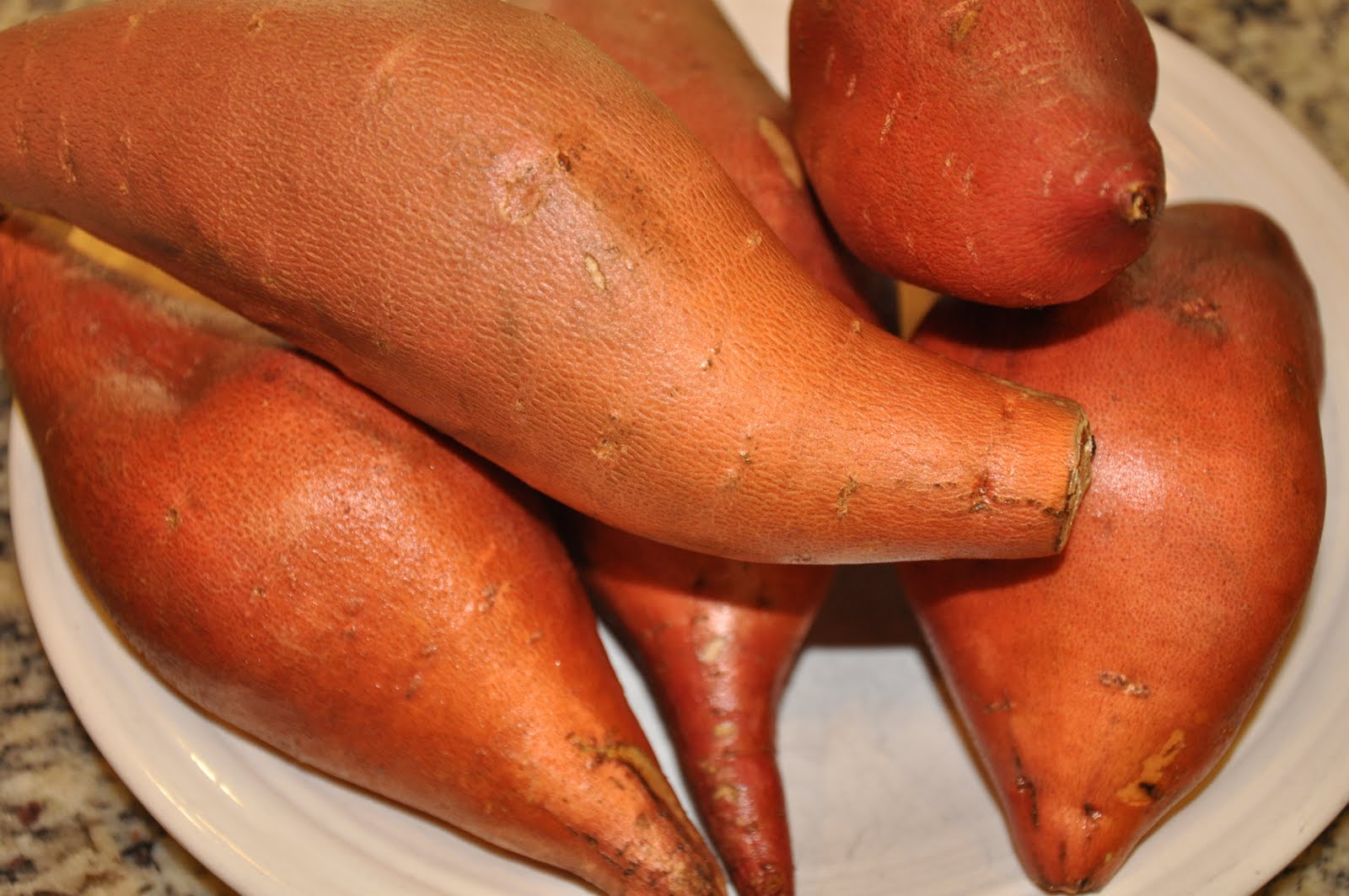
Turns out sweet potatoes and yams are not related biologically! Most likely what you are buying at the grocery store in the U.S. are sweet potatoes, related to morning glories, while yams are related to grasses. So what you see in the photo above are sweet potatoes. I love them; I mix sweet potato puree with oatmeal and maple syrup in the morning.
Sweet potatoes are easy to cook and you don't need to peel them. Just wash, quarter and then halve the quarters. Fill a large saucepan with one inch of water and then put in your steamer basket. Add the potato pieces, cover and heat on high until you hear the water boil. Then turn down the heat to medium-low and start checking for tenderness after 15 minutes. I cooked 3.72 pounds of sweet potatoes in 20 minutes which yielded 72 ounces of puree. The potatoes are cooked when you can mash them with a fork.
Take the potatoes out of the pan, set aside and reserve the cooking water. Once they are cool enough to handle, pull off the skin and puree, adding cooking water as needed to get a yogurt-like consistency. Spoon the puree into ice cube trays and cool in the fridge for an hour. Freeze overnight and store the cubes in a sealed plastic bag in the freezer for up to six months. To serve just reheat one or more cubes in the microwave to room temperature.
Organic sweet potatoes cost me $0.08 per ounce. Earth's Best Organic 1st Foods Sweet Potatoes are $0.69 per ounce.
For older babies and adults: You can add butter, maple syrup, cinnamon, nutmeg, a little cayenne...whatever spice will complement the meal you are serving.

Monday, August 2, 2010
P is for Pear...

Pear sauce is quite decadent; I like to pair it with skinny jeans and gold, high-heeled gladiator sandals. Oh wait, we're talking about baby food, not fashion, sorry. But pear sauce is decadent because it takes a lot of pears to make a little bit of sauce. I purchased 5.26 lbs of pears which yielded only 64 ounces of puree. Nonetheless, it is delicious.
You will need to peel and chop the pears to get a really smooth puree. Put the chopped pears in a saucepan, cover and turn heat to medium. If the pears aren't quite ripe, you will need to add a little bit of water. Cook over medium until fork tender; start checking after five minutes. Once cooked, strain the pears, reserving the cooking liquid. Puree until smooth, using cooking liquid if needed. Freeze overnight in ice cube trays and store for up to six months in a sealed plastic bag in the freezer.
The organic pears cost $0.16 per ounce to prepare. Earth's Best Organic 1st Pears costs $0.28 per ounce.
FOR OLDER BABIES AND ADULTS: Add one part fresh pureed raspberries to four parts pear sauce for a delicious dessert.
Monday, July 26, 2010
B is for Butternut Squash

When I first started making baby food, I didn't own a steamer basket or know what butternut squash looked like so here is a picture of it. B squash is very unassuming, ugly almost but the flesh inside is a beautiful shade of orange. The flavor is like most hard winter squashes, slightly nutty and earthy. I love it still - I would take mashed squash over mashed potatoes any day!
I have tried all sorts of cooking methods for this squash and finally found one that is relatively easy - actually easier than apples. Rinse off the outer skin then set the squash on its side on a cutting board that isn't going to move on you. Take your really wicked (read: large and sharp) bread knife and cut off both ends, then in half crosswise. Scoop out the seeds in the bottom half. Now set one half on its cut end and quarter lengthwise. Do this to both halves and now you have eight pieces. If you got a smaller squash you are done, otherwise a large squash may require you to cut in halves again so the pieces are small enough to fit in your pot. (Notice we didn't even attempt to peel this sucker - aren't you glad you know me!) Ta-da! Six minutes to chop this baby up for cooking! Better than the 20 minutes to peel and chop apples. Get your large sauce pan, put a steamer basket in the bottom and fill with water to the bottom of the steamer basket. Dump in all your squash pieces, cover and turn the heat to high. Once you hear it boiling lower the heat to simmer (medium-low) and cook; start checking tenderness at 20 minutes. A fork should completely pierce the flesh and cause it to fall apart. It took about 23 minutes for me to cook 3.72 lbs of squash. You can use this same cooking method for any hard winter squash.
Once the squash is done, take out the pieces to cool on a cutting board using tongs. Once cool, you can peel off the skin and puree in your blender, food processor or immersion blender. Save some cooking water to add to the puree for a yogurt-like smoothness. (See photo below, that is actually sweet potato puree but they look the same...) Let the puree chill in the fridge and once cool, fill up your ice cube trays and freezer overnight. Once frozen, store the cubes of squash in sealed plastic bags for up to 6 months. Just reheat to room temperature as needed. For older babies you can add one tablespoon of butter and two tablespoons of orange juice per three cups of puree. Taste it - you might want to add more butter or OJ.
I bought two butternut squashes totally 3.72 pounds for $1.99 per pound, or $7.40. I made 53 ounces which comes out to $0.14 per ounce. Earth's Best Organic Butternut Squash is $1.19 for 4 ounces or $0.30 per ounce.

WARNING: Apparently it doesn't matter if you breastfeed your baby exclusively for six months, make all of her baby food and only provide healthy snacks...she will still tell you "Everything tastes delicious at McDonald's, Mom!" Darnit!!!

Tuesday, July 20, 2010
Apples to Applesauce

I prepared the five foods mentioned in my previous post so that I could give you detailed cooking instructions and associated costs of making your own baby food. I have four ice cube trays with 16-one ounce cubes. I purchased enough food to fill up the ice cube trays, making approximately 64 ounces of frozen purees. I made organic baby food, none of which was on sale so the cost per ounce may be lower for you if you catch a sale or buy non-organic food.
I decided to start with apples. If you have never made homemade applesauce, I am warning you it is so good you will become addicted and store bought will never taste the same again. To get a smooth puree you will need to chop and peel the apples. Add them to a large saucepan with enough water to cover half the apples. Cover the pan and bring to a boil, reduce heat to a simmer and cook until the apples fall apart when pierced with a fork. I bought 6.38 pounds of apples - it took me 20 minutes to prepare them and 20 minutes to cook them. Start checking for doneness at 10 minutes so you don't burn the apples or your pan. Once the apples are cooked, drain them, saving the cooking water. Puree them in a blender, food processor, or using an immersion blender, adding 1/4 cup of the cooking water at a time until you get a really smooth consistency - like yogurt. Cool the sauce in the fridge, then fill your ice cube trays and freeze overnight. Once the sauce is frozen you can transfer it to a labelled, sealed gallon plastic bag.
 When needed just reheat to room temperature in the microwave. If you are traveling put the cubes in a sealed bowl. If they haven't defrosted by the time you need them, you can add hot water. Cooked applesauce will keep in the refrigerator for about a week, frozen in the freezer for about six months. Once you defrost it, don't refreeze the leftovers, you will need to throw it out.
The organic apples cost me $0.20 per ounce to make. Earth's Best Organic 1st Foods Applesauce costs on average $0.69 per jar or $0.28 per ounce.
Monday, July 5, 2010
First Foods - Intro
I always get asked what foods to start baby on, so I thought I would blog about what I think the first foods should be, with brief cooking descriptions for each. I chose five foods plus cereal which will give baby a new food every 4 to 5 days that first month. Check back each week as I will give in-depth cooking descriptions, photos and cost analyses for each food!
Cereal
I started both my girls on rice cereal mixed with breast milk. I gave that to them once a day for 4 or 5 days. Those first 4 or 5 days I watched to make sure they were ready to eat and able to move food from the front of their mouth to the back. Also, this was a time to look for any allergic reactions such as diaper rash, mouth rash or eczema. Rice cereal can be constipating, at least it was for my girls, so I switched them to whole grain or oatmeal baby cereal after those first several days.
However, you don't have to start with cereal! I have a friend who is gluten intolerant so she started her son on butternut squash first, skipping cereal all together. Choose the food that works with your family's food history and has been agreed upon by you and your baby's pediatrician.
Butternut Squash
This is a classic on most doctors' and baby food professionals' lists. It is mild in flavor and easy on the gut. Also, it is easy to cook (trust me - I will explain how) and purees up very smooth. This is very important - first foods should be as smooth as pre-stirred yogurt.
To cook: take one squash, rinse, chop off both ends, then quarter it as well. Depending on how big the squash and how big your cooking pot you may need to halve those quarters. Place in a steamer basket, in your big cooking pot with water just up to the bottom of the steamer basket. Steam until tender - start checking after 20 minutes but be forewarned it could take up to 45 minutes. Make sure that the squash falls apart when you prick it with a fork all the way through the pieces. Using tongs, take out the pieces and let cool on a cutting board. Once you can touch them, peel off the skin, put them in your blender (food processor, immersion blender) and puree. Add cooking water as needed to get that yogurt smoothness. See not difficult at all!
Sweet Potatoes
Another classic, slightly sweet veggie which baby will love, and it is easy on the gut.
To cook: cook these the same as the butternut squash. Start checking your pieces after 10 minutes of cooking. You will probably need to add cooking water to get a smooth puree.
Zucchini
Here is a green veggie for baby to start eating. I like to give baby a variety of veggie and fruit colors to start - I think variety is healthier. Zucchini has a mild flavor and isn't known to trigger allergies, unlike peas, which are a legume and can be allergenic.
To cook: rinse 5 small zucchini, cut off the ends, and slice into 1/4 inch rounds. Steam and start checking for tenderness after 5 minutes. You may not need to add cooking water to get these pureed smooth.
Apples
These are sooooooooooo yummy. I like to start baby off with veggies and fruit. Applesauce is easy on the tummy and when mixed with other foods, adds sweetness. After the first month, baby should start on chunkier purees so you can stop making applesauce and buy a store brand. Look for one that contains only apples - make sure it is unsweetened. I like Trader Joe's Unsweetened Applesauce.
To cook: to get really smooth applesauce you are going to have to peel and chop the apples. Use 4 apples, peeled and chopped. Add to a sauce pan with about a 1/4 cup water. Cook, checking to make sure the water hasn't boiled off. Start checking for tenderness after about 10 minutes. Puree, adding the cooking water and more water if needed for a smooth puree.
Pears
Another sweet fruit that purees really smooth and is easy to cook.
To cook: peel and chop 4 pears. Add to a sauce pan and cook, checking after 5 minutes for tenderness. Stir frequently and turn down the heat if they start to brown. Puree.
You may ask why I didn't pick any of the following:
Carrots: they can be constipating, so I save them for the following month.
Green Beans: I have never been able to puree them smooth enough for baby, so I save them for a first finger food - just boil and then cut into small pieces.
Avocado: these are not cooked, just pureed for baby but I can't get them smooth enough so I save them for the following month to counter act the carrots.
Banana: I hate bananas - yuck! These don't need to be cooked, just pureed for baby but I can't get them smooth enough so I save them for the following month. Warning: these are constipating like cooked carrots so serve with avocados.
Cereal
I started both my girls on rice cereal mixed with breast milk. I gave that to them once a day for 4 or 5 days. Those first 4 or 5 days I watched to make sure they were ready to eat and able to move food from the front of their mouth to the back. Also, this was a time to look for any allergic reactions such as diaper rash, mouth rash or eczema. Rice cereal can be constipating, at least it was for my girls, so I switched them to whole grain or oatmeal baby cereal after those first several days.
However, you don't have to start with cereal! I have a friend who is gluten intolerant so she started her son on butternut squash first, skipping cereal all together. Choose the food that works with your family's food history and has been agreed upon by you and your baby's pediatrician.
Butternut Squash
This is a classic on most doctors' and baby food professionals' lists. It is mild in flavor and easy on the gut. Also, it is easy to cook (trust me - I will explain how) and purees up very smooth. This is very important - first foods should be as smooth as pre-stirred yogurt.
To cook: take one squash, rinse, chop off both ends, then quarter it as well. Depending on how big the squash and how big your cooking pot you may need to halve those quarters. Place in a steamer basket, in your big cooking pot with water just up to the bottom of the steamer basket. Steam until tender - start checking after 20 minutes but be forewarned it could take up to 45 minutes. Make sure that the squash falls apart when you prick it with a fork all the way through the pieces. Using tongs, take out the pieces and let cool on a cutting board. Once you can touch them, peel off the skin, put them in your blender (food processor, immersion blender) and puree. Add cooking water as needed to get that yogurt smoothness. See not difficult at all!
Sweet Potatoes
Another classic, slightly sweet veggie which baby will love, and it is easy on the gut.
To cook: cook these the same as the butternut squash. Start checking your pieces after 10 minutes of cooking. You will probably need to add cooking water to get a smooth puree.
Zucchini
Here is a green veggie for baby to start eating. I like to give baby a variety of veggie and fruit colors to start - I think variety is healthier. Zucchini has a mild flavor and isn't known to trigger allergies, unlike peas, which are a legume and can be allergenic.
To cook: rinse 5 small zucchini, cut off the ends, and slice into 1/4 inch rounds. Steam and start checking for tenderness after 5 minutes. You may not need to add cooking water to get these pureed smooth.
Apples
These are sooooooooooo yummy. I like to start baby off with veggies and fruit. Applesauce is easy on the tummy and when mixed with other foods, adds sweetness. After the first month, baby should start on chunkier purees so you can stop making applesauce and buy a store brand. Look for one that contains only apples - make sure it is unsweetened. I like Trader Joe's Unsweetened Applesauce.
To cook: to get really smooth applesauce you are going to have to peel and chop the apples. Use 4 apples, peeled and chopped. Add to a sauce pan with about a 1/4 cup water. Cook, checking to make sure the water hasn't boiled off. Start checking for tenderness after about 10 minutes. Puree, adding the cooking water and more water if needed for a smooth puree.
Pears
Another sweet fruit that purees really smooth and is easy to cook.
To cook: peel and chop 4 pears. Add to a sauce pan and cook, checking after 5 minutes for tenderness. Stir frequently and turn down the heat if they start to brown. Puree.
You may ask why I didn't pick any of the following:
Carrots: they can be constipating, so I save them for the following month.
Green Beans: I have never been able to puree them smooth enough for baby, so I save them for a first finger food - just boil and then cut into small pieces.
Avocado: these are not cooked, just pureed for baby but I can't get them smooth enough so I save them for the following month to counter act the carrots.
Banana: I hate bananas - yuck! These don't need to be cooked, just pureed for baby but I can't get them smooth enough so I save them for the following month. Warning: these are constipating like cooked carrots so serve with avocados.
Monday, June 28, 2010
3 More Things to do with Zucchini

We have had a cold and rainy start to summer so not much else is growing in my garden except greens and some hardy strawberries. We should be in zucchini season so I thought I would blog about that ubiquitous squash. I actually didn't plant any zucchini because we are always given more than we can eat; in fact I still have some frozen from last summer! Following are my three favorite ways to prepare it for the family. Any summer squash can be used in place of zucchini in the recipes.
ONE: Zucchini is a great first food for baby; it is mild and easy to cook and puree. Just wash it, cut off the ends, and slice. Steam the slices until they begin to fall apart - start checking after 5 minutes. Once they are cooked, puree, adding cooking water if needed. And voila, easy baby food. You can flavor it with salt and pepper for older kids. Freeze the leftovers in an ice cube tray (see photo above) to store for later. Pureed zucchini is also great mixed with other purees; we like it with apple or pear sauce.
TWO: For babies who are just starting finger foods, shredded zucchini is perfect. Just wash, slice off the ends and shred with a cheese grater. You can serve it alone or in a pasta salad - try it with cooked orzo pasta, shredded carrots, shredded Parmesan, and tossed with balsamic vinaigrette.
THREE: Veggie Enchilada Casserole, this serves 6 and is good for babies who have mastered finger foods.
1 T olive oil
1 yellow onion, chopped
1 zucchini, shredded
1 can diced tomatoes, drained; or three small tomatoes, chopped
1 can black beans, rinsed and drained
1 1/2 cups corn, frozen or fresh
1 t ground cumin
1 large can enchilada sauce (we like the green)
1 bag shredded sharp cheddar cheese (splurge on the pre-shredded, you'll thank me later)
6 to 8 taco-sized corn tortillas, cut into quarters
Preheat oven to 350 deg F. Butter a 9x13 glass baking dish and set aside. Saute the onion in a deep saute pan with the olive oil. Cook over medium until just starting to soften. Meanwhile, in a large mixing bowl, add the zucchini, tomatoes, black beans, corn and cumin and stir. Add the veggie mix to the onion and cook until heated through, 3 to 5 minutes.
Cover the bottom of the glass baking dish with a single layer of tortilla pieces. Next, spread half the veggies over the tortillas, then half the enchilada sauce, then half the cheese. Repeat the layers once more, cover with foil and bake for 15 minutes. Remove the foil and bake for 10 more minutes. Serve with a green salad and orange slices.
Monday, June 7, 2010
Garden Delights

My garden is open for business. I just put my order in with my five-year-old and she picks what I need. This is fabulous! I was able to add fresh oregano to my pico de gallo and fresh rosemary to my roasted potatoes without a missing a beat. (I was listening to some new music, so it was important not to miss a beat.) But the best part has been the greens. The photo above was my first harvest! Can you believe all that? I was giving it away left and right and we still have had salads for dinner every night. We enjoy salads so much at our house we have replaced Friday Night Pizza Night with Friday Night Make Your Own Salad Night. (Whoo-hoo! That means I don't even have to cook!)
But with a baby it is a challenge to offer greens; they are hard to chew for little ones, especially if you don't have molars! Also, greens are difficult to spear on a fork which can cause frustration. So I tried creamed spinach, but I didn't like it and the baby turned her nose up at it as well. I used the recipe in Hungry Monkey, you could also try The Joy of Cooking. Until she could chew, I offered green purees such as zucchini, peas, and broccoli when the rest of the family was eating a salad. Once she moved on to finger foods, I quartered and steamed Brussels sprouts for her. Now that she is chewing like a pro, I offered her chopped Napa cabbage the other night and she ate it right up. I have started putting a little salad on her plate each night and one of these days she will love it - I just know it!
Pureed Peas
I use frozen peas because they are picked in season and I think they taste better than canned. Also, I like to boil the peas, so they don't lose any moisture.
1 bag frozen peas or fresh
1 teaspoon butter
chopped mint to taste
Drop the frozen peas in boiling water and cook until tender. Drain, but reserve cooking liquid. Puree and add cooking liquid to get the consistency you need. At six months for a first food, it should be runny like yogurt. After about a month of eating runny purees and trying different foods, you can make the purees a little thicker, similar to pesto. Once they get the hang of thicker purees, you can move on to mashing the veggies and adding just a small amount of water. At about nine months when baby has had a variety of foods, you can add butter and mint to the puree. Yum! This puree is something the whole family can enjoy, adding salt and pepper, butter, and mint as needed.
Our Favorite Salad So Far
mixed greens, chopped
carrots, shredded
radishes, shredded
fresh corn, kernel cut off the cob
avocado, chopped
Parmesan cheese, shaved
Put ingredients in individual bowls so everyone can make their own and serve with balsamic vinaigrette.
Sunday, February 21, 2010
Dinner Tonight...
I thought I would try something new and post a dinner menu every week that includes a dish for babies through toddlers. One meal to feed everyone in the family! Please comment and let me know what you think.
Tonight try Mexican Corn and Bean Soup with applesauce, a green salad and corn bread. This is not the soup I make, I use the Colophon Cafe's recipe which I can't publish, but it is very similar. Try their other soups, we love the African Peanut and the Split Pea.
6 months and older
Peel and chop one apple per person and put in a medium saucepan. Add water to cover the bottom and cook on medium heat, stirring often for about 10 minutes or until very fork tender. Strain the apples and reserve the cooking water. Puree the apples, using some of the cooking water if needed. For new eaters, you will want this really smooth and soupy. For babies that have been eating for about a month, you don't have to puree it perfectly smooth. Once Clare moved beyond first foods, at about 7 months, I started using store bought applesauce. I really like Trader Joe's Unsweetened Applesauce.
9 months and older
Reserve some of the beans and mash for the older babies. Serve warm with the applesauce and cornbread.
11 months and older
For the finger food eaters, strain the cooked soup and let them pick out the tomatoes, corn and beans to eat. Serve with cornbread and applesauce.
Green salad for 2 years and older
Clare is 16 months now and still has trouble with lettuce but I continue to offer it to her. Without a lot of teeth, greens are difficult to chew and move from the front of the mouth to the back.
Enjoy dinner!
Tonight try Mexican Corn and Bean Soup with applesauce, a green salad and corn bread. This is not the soup I make, I use the Colophon Cafe's recipe which I can't publish, but it is very similar. Try their other soups, we love the African Peanut and the Split Pea.
6 months and older
Peel and chop one apple per person and put in a medium saucepan. Add water to cover the bottom and cook on medium heat, stirring often for about 10 minutes or until very fork tender. Strain the apples and reserve the cooking water. Puree the apples, using some of the cooking water if needed. For new eaters, you will want this really smooth and soupy. For babies that have been eating for about a month, you don't have to puree it perfectly smooth. Once Clare moved beyond first foods, at about 7 months, I started using store bought applesauce. I really like Trader Joe's Unsweetened Applesauce.
9 months and older
Reserve some of the beans and mash for the older babies. Serve warm with the applesauce and cornbread.
11 months and older
For the finger food eaters, strain the cooked soup and let them pick out the tomatoes, corn and beans to eat. Serve with cornbread and applesauce.
Green salad for 2 years and older
Clare is 16 months now and still has trouble with lettuce but I continue to offer it to her. Without a lot of teeth, greens are difficult to chew and move from the front of the mouth to the back.
Enjoy dinner!
Sunday, January 31, 2010
Tacos All Around
We had a yummy dinner tonight and I thought I would share the recipes because they are appropriate for all ages. Tacos are one of our favorites and we usually have them two or three times a month. Recently, I tried the Tempeh Tacos recipe from Cynthia Lair's Feeding the Whole Family. I used lean ground beef instead of tempeh and it is just as delicious. I paired it with cumin rice and beans, creamy coleslaw from Ms. Lair's cookbook, and my friend Alysa's guacamole. I am still in food heaven - you know that feeling when your mouth still tastes good and your tummy feels perfectly full. Hmm...yeah! You will have to look up Ms. Lair's recipes yourself but I have included below the beans and guac recipes for you as well directions for feeding your babes. Enjoy!
Cumin Rice and Beans
Cook one cup of rice as per the package directions including the recommended fat (either olive oil or unsalted butter). Add a 1/2 teaspoon of cumin to the rice. A few minutes before the rice is done, stir in a can of drained and rinsed black beans. Let that sit for a few minutes to warm up the beans.
Guacamole
(from Alysa and Lucas)
Mash one avocado with the juice of 1/2 lime, a pinch of kosher salt, a clove of minced garlic and a small handful of chopped cilantro. Add more lime juice or salt to taste if needed.
6 months and older
Reserve some mashed avocado for the beginning eaters.
8 months and older
Reserve some cumin rice and serve with mashed avocado.
10 months and older
Serve beginning finger food eaters the rice and beans. Mash the beans slightly to break the skins for easier digestion.
12 months and older
Serve them everything but the chips! Chips are an extreme choking hazard and shouldn't be offered until year three. They also might have trouble with the coleslaw, Clare at 15 months and with only her first year molars still can't really chew or move greens in her mouth yet.
Cumin Rice and Beans
Cook one cup of rice as per the package directions including the recommended fat (either olive oil or unsalted butter). Add a 1/2 teaspoon of cumin to the rice. A few minutes before the rice is done, stir in a can of drained and rinsed black beans. Let that sit for a few minutes to warm up the beans.
Guacamole
(from Alysa and Lucas)
Mash one avocado with the juice of 1/2 lime, a pinch of kosher salt, a clove of minced garlic and a small handful of chopped cilantro. Add more lime juice or salt to taste if needed.
6 months and older
Reserve some mashed avocado for the beginning eaters.
8 months and older
Reserve some cumin rice and serve with mashed avocado.
10 months and older
Serve beginning finger food eaters the rice and beans. Mash the beans slightly to break the skins for easier digestion.
12 months and older
Serve them everything but the chips! Chips are an extreme choking hazard and shouldn't be offered until year three. They also might have trouble with the coleslaw, Clare at 15 months and with only her first year molars still can't really chew or move greens in her mouth yet.
Monday, January 11, 2010
Mixers II
Clare, being the darling independent spirit that she is, has decided not to eat bananas anymore. Darn, I use those to regulate her stool (they are constipating) and fill her tummy. So I have made an end run around her preferences and hidden them in smoothies; my next "mixer" to discuss. Smoothies are really yummy and can serves as breakfast, lunch or snack depending on what you hide in them. You can also add in any supplements you want. I use two kinds, a dairy smoothie and a green smoothie.
For the dairy smoothie, start with a cup of juice, add a half cup of plain yogurt or milk, a banana, and a half to a whole cup of frozen fruit. Blend until smooth. Our favorites are: orange juice, yogurt, banana and frozen strawberries or grape juice, yogurt, banana and frozen raspberries.
For the green smoothie, start with two cups of fresh spinach leaves (you can also add in some kale or beet greens), add in 1 cup of water and blend until smooth. Then add in your banana and frozen fruit. Do not add in dairy, which will inhibit the absorption of vitamin C in the spinach.
Kids love to help so they can dump in everything and push the blend button for you.
Enjoy!
For the dairy smoothie, start with a cup of juice, add a half cup of plain yogurt or milk, a banana, and a half to a whole cup of frozen fruit. Blend until smooth. Our favorites are: orange juice, yogurt, banana and frozen strawberries or grape juice, yogurt, banana and frozen raspberries.
For the green smoothie, start with two cups of fresh spinach leaves (you can also add in some kale or beet greens), add in 1 cup of water and blend until smooth. Then add in your banana and frozen fruit. Do not add in dairy, which will inhibit the absorption of vitamin C in the spinach.
Kids love to help so they can dump in everything and push the blend button for you.
Enjoy!
Sunday, December 13, 2009
Your Secret Weapon...
My sister was telling me about a side dish she served at dinner the other night, chopped fruit mixed with yogurt and I thought...oh yeah, I need to serve fruit at dinner more often. That is your secret weapon - kids will always eat fruit. It is a great accompaniment to dinner as well as a substitute for dessert. If you can mix fruit in with your main dish, you may have a hit on your hands. Below are some recipes for you to try. Enjoy!
6 months and older
Once baby has had both applesauce and squash, try mixing them together. Experiment with the proportions but I like 1 part apple to 6 parts squash. You can also serve this as a side dish for the rest of the family with a little freshly ground nutmeg.
8 months and older (see note below)
Chicken Couscous with Dried Fruit (adapted from Food Made Fast: Weeknight (Williams-Sonoma) by Melanie Barnard and Chuck Williams http://www.amazon.com/Food-Made-Fast-Weeknight-Williams-Sonoma/dp/0848731379/ref=sr_1_2?ie=UTF8&s=books&qid=1260771546&sr=8-2)
serves 4
2 cups shredded roast chicken
1/4 cup lemon juice
2 Tablespoons olive oil
1 yellow onion, chopped
3 cloves garlic, minced
1 1/2 teaspoons ground cumin
3/4 teaspoon cinnamon
1 cup mixed dried fruits, chopped
1 1/2 cups chicken broth
1 cup couscous
1/2 cup sliced almonds, toasted
Saute onion with olive oil in a large saucepan over medium heat, until softened, about 4 minutes. Add the garlic and saute an additional 1-2 minutes. Add the cumin and cinnamon, and then stir in the chicken, lemon juice, dried fruits, and broth. Bring the mixture to a boil, reduce the heat and simmer for 5 minutes.
Now add in the couscous, re-cover and remove from the heat. Let stand until the liquid is absorbed and the couscous is softened, about 5 minutes. Garnish with the almonds and serve.
Note: To modify this for younger babies you can add the chicken in at the end and use water instead of chicken broth. To serve for the rest of the family just add in the chicken (warmed in the microwave) and garnish with the almonds.
10 months and older
Spicy Apricot-Glazed Chicken from Everyday Food Magazine: http://www.marthastewart.com/recipe/spicy-apricot-glazed-chicken
This recipe is great: three ingredients and it cooks up in 15 minutes start to finish! I have a terrible gas broiler so it took an additional 5 minutes at the end. I did include the red pepper flakes. It was slightly spicy but neither of my daughters complained and both asked for seconds!
6 months and older
Once baby has had both applesauce and squash, try mixing them together. Experiment with the proportions but I like 1 part apple to 6 parts squash. You can also serve this as a side dish for the rest of the family with a little freshly ground nutmeg.
8 months and older (see note below)
Chicken Couscous with Dried Fruit (adapted from Food Made Fast: Weeknight (Williams-Sonoma) by Melanie Barnard and Chuck Williams http://www.amazon.com/Food-Made-Fast-Weeknight-Williams-Sonoma/dp/0848731379/ref=sr_1_2?ie=UTF8&s=books&qid=1260771546&sr=8-2)
serves 4
2 cups shredded roast chicken
1/4 cup lemon juice
2 Tablespoons olive oil
1 yellow onion, chopped
3 cloves garlic, minced
1 1/2 teaspoons ground cumin
3/4 teaspoon cinnamon
1 cup mixed dried fruits, chopped
1 1/2 cups chicken broth
1 cup couscous
1/2 cup sliced almonds, toasted
Saute onion with olive oil in a large saucepan over medium heat, until softened, about 4 minutes. Add the garlic and saute an additional 1-2 minutes. Add the cumin and cinnamon, and then stir in the chicken, lemon juice, dried fruits, and broth. Bring the mixture to a boil, reduce the heat and simmer for 5 minutes.
Now add in the couscous, re-cover and remove from the heat. Let stand until the liquid is absorbed and the couscous is softened, about 5 minutes. Garnish with the almonds and serve.
Note: To modify this for younger babies you can add the chicken in at the end and use water instead of chicken broth. To serve for the rest of the family just add in the chicken (warmed in the microwave) and garnish with the almonds.
10 months and older
Spicy Apricot-Glazed Chicken from Everyday Food Magazine: http://www.marthastewart.com/recipe/spicy-apricot-glazed-chicken
This recipe is great: three ingredients and it cooks up in 15 minutes start to finish! I have a terrible gas broiler so it took an additional 5 minutes at the end. I did include the red pepper flakes. It was slightly spicy but neither of my daughters complained and both asked for seconds!
Monday, November 16, 2009
Squash Me
It is winter squash season and I think they are my favorite veggies. However, one of these days I am going to lose a finger trying to cut them open. Maybe that is why I love them, because they are so hard to get in to. The best knives to use are either large, serrated bread knives or reciprocating knives. Below, are some winter squash recipes for you to try. Enjoy!
6 months and older
Butternut Squash Puree
1 medium butternut squash
This is the easiest method I have found to cook butternut squash for a puree.
Cut the ends off, then split the squash down the middle and clean out the seeds. Then quarter each half and put the pieces in a steamer. Cook until fork tender. Once the pieces have cooled slightly, use a spoon to scoop out the flesh. Puree with some cooking water if needed. For older babies and adults (you can serve this instead of mash potatoes with dinner) add some butter and a tablespoon or two of orange juice.
8 months and older
Pumpkin Waffles
These are Bailey's favorite; she ate four for breakfast yesterday morning!
1 sugar pumpkin (you can also use canned pumpkin puree)
Cut off the top of the pumpkin, split in half and scoop out the seeds. Put face down on a foil lined baking sheet and bake at 350 deg for about 45 minutes or until fork tender.
The waffle recipe is from epicurious.com.
http://www.epicurious.com/recipes/food/views/Pumpkin-Waffles-104264
You can freeze the waffles in a single layer on a baking sheet. Once frozen, transfer to an airtight container and pop in the toaster when needed.
9 months and older
Rice stuffed squash
My usual recipe is from Everyday Food Magazine (http://www.marthastewart.com/recipe/wild-rice-stuffed-squash). However, Mollie Katzen of Moosewood fame has just published a new cookbook titled "Get Cooking: 150 Simple Recipes to Get You Started in the Kitchen" (http://www.molliekatzen.com/get_cooking_promo.php) with a rice stuffed squash recipe that sounds even better. The recipe was published in our local paper so here is a link: http://www.bellinghamherald.com/321/story/1161180.html.
Just remember to reserve the almonds for an adult garnish if serving to babies.
6 months and older
Butternut Squash Puree
1 medium butternut squash
This is the easiest method I have found to cook butternut squash for a puree.
Cut the ends off, then split the squash down the middle and clean out the seeds. Then quarter each half and put the pieces in a steamer. Cook until fork tender. Once the pieces have cooled slightly, use a spoon to scoop out the flesh. Puree with some cooking water if needed. For older babies and adults (you can serve this instead of mash potatoes with dinner) add some butter and a tablespoon or two of orange juice.
8 months and older
Pumpkin Waffles
These are Bailey's favorite; she ate four for breakfast yesterday morning!
1 sugar pumpkin (you can also use canned pumpkin puree)
Cut off the top of the pumpkin, split in half and scoop out the seeds. Put face down on a foil lined baking sheet and bake at 350 deg for about 45 minutes or until fork tender.
The waffle recipe is from epicurious.com.
http://www.epicurious.com/recipes/food/views/Pumpkin-Waffles-104264
You can freeze the waffles in a single layer on a baking sheet. Once frozen, transfer to an airtight container and pop in the toaster when needed.
9 months and older
Rice stuffed squash
My usual recipe is from Everyday Food Magazine (http://www.marthastewart.com/recipe/wild-rice-stuffed-squash). However, Mollie Katzen of Moosewood fame has just published a new cookbook titled "Get Cooking: 150 Simple Recipes to Get You Started in the Kitchen" (http://www.molliekatzen.com/get_cooking_promo.php) with a rice stuffed squash recipe that sounds even better. The recipe was published in our local paper so here is a link: http://www.bellinghamherald.com/321/story/1161180.html.
Just remember to reserve the almonds for an adult garnish if serving to babies.
Sunday, October 25, 2009
The Starter Pack
My dear friend Laurel, who has two darling kids, received some fabulous handouts from her pediatrician on starting solid foods. She passed the information on to me and I was very impressed on the content and structure. So I thought I would add the techniques I used in introducing solids to my girls and pass it on to all of you. Bon Appetite!
Cereal
*start around 4-6 months (Bailey started at 7 1/2 mos, Clare at 5 1/2 mos)
*offer rice ceral first, then oatmeal, then barley (I switched to oatmeal after 4 days once I knew the girls could tolerate cereal because rice cereal is so constipating)
*stick with the same cereal at least 3-4 days before moving on to a new one
*mix 1 tablespoon cereal with your baby's milk and make it very thin and soupy
*gradually increase to 3-4 tablespoons cereal
*offer cereal once a day at first, working up to 2-3 times per day (offer it when baby is alert but bored and eat or drink something yourself while feeding baby so baby learns the social aspect of eating)
*daily milk intake should not decrease (By the time I started solids with the girls they were nursing first thing in the morning, before the morning nap, before the afternoon nap and before bedtime. This meant that I was feeding them solids at different times than their nursings. Some experts recommend feeding cereal first and then baby's milk afterwards.)
Fruits and Vegetables
*some experts recommend fruits first and some recommend veggies first (I did a combination including apples, pears, butternut squash, yams, carrots, zucchini, bananas, and avocados)
*feed fruits and vegetables with cereal twice a day at breakfast and dinner
*no minimum amount of fruit or vegetable, offer up to 4 ounces per feeding
*offer one fruit or vegetable at a time for 3-4 days before introducing another
*offer light colored fruits and yellow vegetables first (apples, pears, bananas, butternut squash, yams, zucchini, carrots)
*offer other colored fruits and green vegetables next (peaches, plums, prunes, peas, green beans, beets)
*begin feeding at lunch once baby's appetite increases
Protein
*start at 8 months
*this may include legumes, quinoa, tofu, meats (I held off on meats until the girls could "chew" so I didn't have to puree chicken or beef. I don't mind cutting food up into itsy bitsy pieces but the thought of putting meat in my blender was too much for me)
*may be offered twice a day at lunch and dinner
*offer up to 4 ounces per feeding
*introduce new protein every 3-4 days
*once your baby is on protein, their schedule should be:
breakfast - cereal and fruit
lunch - protein with fruit OR veggie
dinner - protein with fruit AND veggie
Cereal
*start around 4-6 months (Bailey started at 7 1/2 mos, Clare at 5 1/2 mos)
*offer rice ceral first, then oatmeal, then barley (I switched to oatmeal after 4 days once I knew the girls could tolerate cereal because rice cereal is so constipating)
*stick with the same cereal at least 3-4 days before moving on to a new one
*mix 1 tablespoon cereal with your baby's milk and make it very thin and soupy
*gradually increase to 3-4 tablespoons cereal
*offer cereal once a day at first, working up to 2-3 times per day (offer it when baby is alert but bored and eat or drink something yourself while feeding baby so baby learns the social aspect of eating)
*daily milk intake should not decrease (By the time I started solids with the girls they were nursing first thing in the morning, before the morning nap, before the afternoon nap and before bedtime. This meant that I was feeding them solids at different times than their nursings. Some experts recommend feeding cereal first and then baby's milk afterwards.)
Fruits and Vegetables
*some experts recommend fruits first and some recommend veggies first (I did a combination including apples, pears, butternut squash, yams, carrots, zucchini, bananas, and avocados)
*feed fruits and vegetables with cereal twice a day at breakfast and dinner
*no minimum amount of fruit or vegetable, offer up to 4 ounces per feeding
*offer one fruit or vegetable at a time for 3-4 days before introducing another
*offer light colored fruits and yellow vegetables first (apples, pears, bananas, butternut squash, yams, zucchini, carrots)
*offer other colored fruits and green vegetables next (peaches, plums, prunes, peas, green beans, beets)
*begin feeding at lunch once baby's appetite increases
Protein
*start at 8 months
*this may include legumes, quinoa, tofu, meats (I held off on meats until the girls could "chew" so I didn't have to puree chicken or beef. I don't mind cutting food up into itsy bitsy pieces but the thought of putting meat in my blender was too much for me)
*may be offered twice a day at lunch and dinner
*offer up to 4 ounces per feeding
*introduce new protein every 3-4 days
*once your baby is on protein, their schedule should be:
breakfast - cereal and fruit
lunch - protein with fruit OR veggie
dinner - protein with fruit AND veggie
Sunday, September 27, 2009
Soup's On!
The weather is starting to turn cold here and that gets me thinking about soups (and finding the perfect down jacket, but that is an entirely different blog: http://www.garancedore.fr/en/) so back to food. Soups are the perfect family food; either they are pureed and baby can eat them or the ingredients are cooked tender and baby can eat them so no extra work for the cook - yeah! Below are some of my favorites:
6 months and older
Potato Leek Soup (from Dandelion Organic Delivery http://www.dandelionorganic.com/)
serves 4 to 6
Bailey doesn't like cream so this a delicious alternative to a creamy potato soup that she loves and requests!
2 large leeks, cut lengthwise, separate, clean; use only the white and pale green parts, chop
2 T unsalted butter
2 cups water
2 cups broth
2 lbs potatoes, peeled, diced into 1/2 pieces
Marjarom - dash
Cook leeks in butter in a medium-sized sauce pan. Cover pan, cook on low heat for 10 minutes, checking often. Do not brown leeks - this will give them a burnt taste.
Add water, broth, and potatoes. Cook for 20 minutes. Scoop about half of the soup mixture into a blender, puree and return to pan. Add dash of marjarom to serve. For baby, reserve some of the pureed half to serve and for the adults, add a dash of tabasco, some salt and pepper.
7 to 9 months
Roasted Fall Vegetable Soup (from Everday Food Magazine)
serves 8
http://www.marthastewart.com/recipe/roasted-fall-vegetable-soup
You can serve the veggies as a side dish without pureeing them and then puree the leftovers for soup another night as well.
9 to 12 months
Chunky Turkey Vegetable Soup (from Everday Food Magazine)
serves 4
http://www.marthastewart.com/recipe/chunky-turkey-vegetable-soup
I use whatever leftover poulty I have, if not, I throw in a half of a can of kidney beans, you could also use quinoa for protein.
6 months and older
Potato Leek Soup (from Dandelion Organic Delivery http://www.dandelionorganic.com/)
serves 4 to 6
Bailey doesn't like cream so this a delicious alternative to a creamy potato soup that she loves and requests!
2 large leeks, cut lengthwise, separate, clean; use only the white and pale green parts, chop
2 T unsalted butter
2 cups water
2 cups broth
2 lbs potatoes, peeled, diced into 1/2 pieces
Marjarom - dash
Cook leeks in butter in a medium-sized sauce pan. Cover pan, cook on low heat for 10 minutes, checking often. Do not brown leeks - this will give them a burnt taste.
Add water, broth, and potatoes. Cook for 20 minutes. Scoop about half of the soup mixture into a blender, puree and return to pan. Add dash of marjarom to serve. For baby, reserve some of the pureed half to serve and for the adults, add a dash of tabasco, some salt and pepper.
7 to 9 months
Roasted Fall Vegetable Soup (from Everday Food Magazine)
serves 8
http://www.marthastewart.com/recipe/roasted-fall-vegetable-soup
You can serve the veggies as a side dish without pureeing them and then puree the leftovers for soup another night as well.
9 to 12 months
Chunky Turkey Vegetable Soup (from Everday Food Magazine)
serves 4
http://www.marthastewart.com/recipe/chunky-turkey-vegetable-soup
I use whatever leftover poulty I have, if not, I throw in a half of a can of kidney beans, you could also use quinoa for protein.
Sunday, September 13, 2009
A is for... Fall
First a note about the blog. Please excuse the mess while I work on the perfect template. I am a professional mom; I get paid (in shoes) so that defines professional, right? Not a professional blogger so this will take some trial and error. Thanks for your understanding!
Fall is my absolute favorite time of year - the crisp morning air, all the yummy apples and of course the fact that I am not sneezing the piss out of myself from allergies - that might have something to do with it. I thought it was high time I posted some recipes since I claim to make baby food! So here are my fall favorites for apples...
6 months
Applesauce is the quintessential first food because it is mild in flavor, nonallergenic, and naturally sweet. I have found, especially when making a puree, that the best way to cook it is to wash, peel, chop and then steam it. Lisa Barnes in Cooking For Baby suggestes quartering and coring the apple, steaming the quarters and then scooping out the flesh. I tried it and it works great for older babies; however, for a really smooth puree, you will want to chop the apples into uniform sizes. So that's it, steam it until fork tender and then puree. Freeze it in ice cube trays, when frozen transfer to an airtight container and then pull out the cubes when needed.
7 to 9 months
For older babies you can add a little bit of cinnamon or grated nutmeg to the puree for flavor. I have served that as a side dish for the family as well. Also, you can skip pureeing and the cubes are a perfect first finger food for baby. Once Bailey and Clare were old enough to tolerate chunkier applesauce I quit making it and purchased Trader Joe's All Natural Unsweetened Apple Sauce. It tastes almost as yummy for a fraction of the labor!
9 months to adult
Mix three parts applesauce to one part pureed raspberries for a yummy family dessert or to mix into oatmeal or plain yogurt. For the grand finale, a "stew" for lack of a better word. I was inspired for this recipe by Lisa Barnes's (in Cooking For Baby) Potato and Butternut Squash Stew and Annabel Karmel's (in Top 100 Baby Purees) Potato, Carrot, and Corn.
Apple Stew
2 Tablespoons unsalted butter
1/2 cup chopped onion
1 1/2 cups apple, peeled, cored and chopped
1 1/2 cups potatoes, peeled and chopped
1 1/2 cups butternut squash, peeled and chopped
1 cup water
Saute the onion in the melted butter over medium heat until just starting to soften. Add the apples, potatoes and squash and cook until everything turns golden. Add water, bring to a boil and then reduce heat. Simmer until the potatoes and squash are tender, about 30 minutes. Serve as a side dish for the whole family and finger food for baby. You can mash this up if baby isn't ready for food pieces but has tried all these ingredients individually; or put this through a food grinder. WARNING: Do not put this in a blender or food processor. The potatoes will turn to glue...unless you are all out of Elmer's.
Enjoy!
Fall is my absolute favorite time of year - the crisp morning air, all the yummy apples and of course the fact that I am not sneezing the piss out of myself from allergies - that might have something to do with it. I thought it was high time I posted some recipes since I claim to make baby food! So here are my fall favorites for apples...
6 months
Applesauce is the quintessential first food because it is mild in flavor, nonallergenic, and naturally sweet. I have found, especially when making a puree, that the best way to cook it is to wash, peel, chop and then steam it. Lisa Barnes in Cooking For Baby suggestes quartering and coring the apple, steaming the quarters and then scooping out the flesh. I tried it and it works great for older babies; however, for a really smooth puree, you will want to chop the apples into uniform sizes. So that's it, steam it until fork tender and then puree. Freeze it in ice cube trays, when frozen transfer to an airtight container and then pull out the cubes when needed.
7 to 9 months
For older babies you can add a little bit of cinnamon or grated nutmeg to the puree for flavor. I have served that as a side dish for the family as well. Also, you can skip pureeing and the cubes are a perfect first finger food for baby. Once Bailey and Clare were old enough to tolerate chunkier applesauce I quit making it and purchased Trader Joe's All Natural Unsweetened Apple Sauce. It tastes almost as yummy for a fraction of the labor!
9 months to adult
Mix three parts applesauce to one part pureed raspberries for a yummy family dessert or to mix into oatmeal or plain yogurt. For the grand finale, a "stew" for lack of a better word. I was inspired for this recipe by Lisa Barnes's (in Cooking For Baby) Potato and Butternut Squash Stew and Annabel Karmel's (in Top 100 Baby Purees) Potato, Carrot, and Corn.
Apple Stew
2 Tablespoons unsalted butter
1/2 cup chopped onion
1 1/2 cups apple, peeled, cored and chopped
1 1/2 cups potatoes, peeled and chopped
1 1/2 cups butternut squash, peeled and chopped
1 cup water
Saute the onion in the melted butter over medium heat until just starting to soften. Add the apples, potatoes and squash and cook until everything turns golden. Add water, bring to a boil and then reduce heat. Simmer until the potatoes and squash are tender, about 30 minutes. Serve as a side dish for the whole family and finger food for baby. You can mash this up if baby isn't ready for food pieces but has tried all these ingredients individually; or put this through a food grinder. WARNING: Do not put this in a blender or food processor. The potatoes will turn to glue...unless you are all out of Elmer's.
Enjoy!
Sunday, September 6, 2009
In the Beginning...
The most common question people ask me (aside from "where did you get those fabulous shoes?" ha ha) is "How do you start feeding your baby?". So I thought I would begin at the beginning. Bai and I were in this great mom's group with kids from 0 to 1 year. I heard from moms with older kids what their struggles were with food. I decided that I wanted Bailey to eat with us; when we ate, what we ate. Since I was nursing Bailey and she wouldn't take a bottle, I naturally became in charge of feeding her solids. However, Mike did and still does most of the grocery shopping (it keeps me from buying too many bags of Oreos!) so I wouldn't always get to pick out her jarred food. I decided (it sounds crazy now, but sleep deprived moms make all sorts of loopy choices) that it would be easier just to make her food. At the time I didn't know what a butternut squash was, how to peel it or how to steam it - in fact, I didn't even have a steamer basket! But, I had a great mom-friend who was going to make her son's food as well - a partner in crime.
So at five months, I tried to give Bailey rice cereal. She wasn't interested. My mother-in-law was visiting and I didn't want her to think I was starving her granddaughter but Bailey would just let it fall out of her mouth. Grandma tried too, to no avail. So while I waited for Bailey to start eating, I would put her in her highchair whenever we were eating and let her play with her baby spoons and sippy cups; that way they weren't strange when it was time to use them. She finally started eating at 7 1/2 months! I would give her cereal once a day when she seemed bored but not tired, at about the same time and I would eat something with her. Rice cereal is very constipating so after a few days, when I knew she was handling it fine, I switched to a mix of grains. I like Earth's Best brand.
Once Bailey (and I did the same thing with Clare, but she started at 5 1/2 months) ate the cereal well and she seemed to be hungrier I started giving her cereal twice and then three times a day. But I didn't want her to get used to cereal for every meal because that is not what we eat. So then I washed, peeled, chopped, steamed and pureed apples, pears, butternut squash, sweet potatoes and zucchini. These are all great first foods because they are mild flavors and low allergenic triggers. I would introduce one every three or four days. I still gave her cereal as well. So that first month Bailey and Clare learned how to eat and were introduced to six foods. I mixed these all up with each other and cereal to give her new flavors. Babies thrive on routine but I constantly changed Bai's foods so that she never had the same thing at the same time. I wanted her routine to be to accept new foods and the only routine about it would be that she would get something to eat.
I still mix pureed fruits with morning oatmeal for the girls (and me! ). Our favorite is peach puree. I just wash, peel, and chop the peaches then puree them and freeze them in ice cube trays. Then I just throw a frozen peach cube into the steaming oatmeal. It cools and flavors the oatmeal for us - yum!

Subscribe to:
Posts (Atom)